
The Future of 3D Printing Isn’t the Printer Anymore
If you’ve been around the maker community for any length of time, you’ve probably noticed something interesting.
The conversations are changing.
A few years ago, every discussion revolved around printer specifications.
How fast can it print?
What’s the build volume?
How many millimeters per second can it push?
How quickly can it spit out a Benchy?
And honestly?
Those conversations still exist.
But they’re becoming less important.
Because over the past week, several major stories have highlighted something much bigger happening across the industry.
The future of 3D printing isn’t about machines anymore.
It’s about ecosystems.
It’s about workflows.
It’s about integrating technologies together in ways that create something larger than the sum of their parts.
And if you’re somebody who’s already combining 3D printing, laser engraving, scanning, product design, and custom manufacturing, you’re probably sitting in one of the best positions possible right now.
Because the truth is, the industry is finally catching up to the way many makers have already been working.
Creality’s Vision Looks a Lot Like the Future
One of the most interesting developments that continues gaining attention comes from Creality’s growing ecosystem strategy.
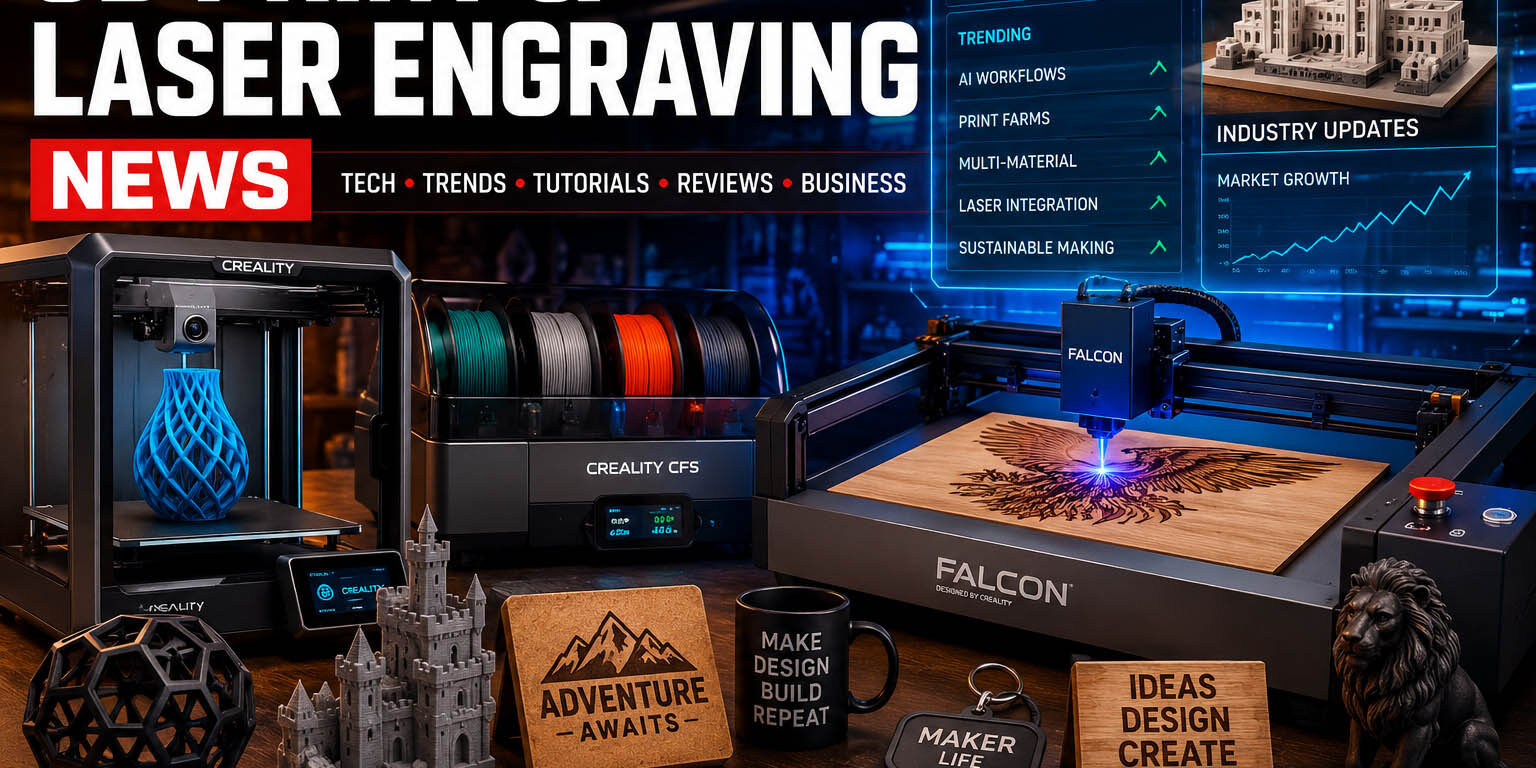
At RAPID + TCT 2026, one of the largest additive manufacturing events in North America, Creality showcased something much bigger than a new printer. According to VoxelMatters’ coverage of the event, the company demonstrated a complete manufacturing ecosystem that combines printers, scanners, laser systems, cloud management, AI tools, and even filament recycling into a connected workflow. (https://www.voxelmatters.com/creality-presents-multi-tool-creation-ecosystem-and-new-hardware-range-at-rapid-tct-2026/)
And honestly?
That grabbed my attention immediately.
Because if you’ve been following my content for a while, you’ll know I’ve always believed the real magic happens when technologies work together.
Think about the workflow.
You scan a broken component using a Raptor Pro.
You repair the model.
You print the replacement part.
Then you move it over to a Falcon laser and engrave branding, part numbers, installation instructions, or customization directly onto the finished product.
That’s not hobby-level production anymore.
That’s manufacturing.
The truth is, we’re watching the barriers between design, scanning, printing, and finishing slowly disappear.
And that’s where the opportunity is.
AI Is Finally Becoming Useful
Let’s talk about AI.
I know.
Everybody is talking about AI.
Every software company suddenly claims to have AI.
Every new product announcement somehow finds a way to include AI.
Most of the time, it’s marketing fluff.
But that’s just it.
The AI story happening inside 3D printing is actually becoming useful.
Instead of trying to replace creators, AI is starting to remove friction.
According to discussions coming out of major additive manufacturing events and software research initiatives, AI is increasingly being used for:
- Print failure prediction
- Automatic support optimization
- Workflow automation
- Design validation
- Slicing improvements
- Material optimization
The truth is, nobody enjoys spending hours troubleshooting preventable failures.
Nobody enjoys wasting filament.
Nobody enjoys restarting a twenty-hour print because a support structure failed halfway through.
If AI can reduce those problems?
That’s valuable.
Very valuable.
But let me explain why I’m still cautious.
AI is excellent until it isn’t.
And when it makes a mistake, it often makes a very confident mistake.
That’s where experience still matters.
The people who will benefit most from AI aren’t the ones who blindly trust it.
They’re the people who understand enough to know when the software is wrong.
That’s an important distinction.
The Open Source Battle Just Got Bigger
One of the most talked-about stories in the 3D printing community recently continues to generate discussion this week.
And honestly?
It has implications far beyond one company.
The controversy surrounding Bambu Lab, OrcaSlicer, and AGPL licensing has evolved into one of the most important discussions the maker community has had in years. Reports from Tom’s Hardware, The Verge, and multiple industry sources have highlighted growing concerns surrounding software restrictions, cloud connectivity, and open-source obligations.
Now don’t get me wrong.
Bambu Lab deserves a tremendous amount of credit.
They helped accelerate consumer 3D printing faster than almost anyone else.
Their printers changed expectations overnight.
Suddenly people expected:
- Automatic calibration
- Reliable printing
- Multi-color workflows
- Cloud integration
- Camera monitoring
And that’s a good thing.
Competition drives innovation.
But the truth is, every convenience comes with a tradeoff.
The more integrated ecosystems become, the more control manufacturers gain.
And that’s creating tension.
Because makers generally love two things:
Convenience.
Freedom.
Unfortunately, those two things don’t always work together.
That’s why this debate matters.
It’s not really about one company.
It’s about what kind of future the community wants.
Multi-Material Printing Is Finally Growing Up
For years, multi-color printing felt like a novelty.
Rainbow dragons.
Color-changing octopuses.
Social media content.
It’s cool and all… but not that useful.
But recently we’ve started seeing something different.
According to coverage of new systems appearing across the industry, companies are increasingly focusing on reducing waste, reducing labor, and simplifying production workflows instead of simply adding more colors.
And honestly?
That’s where the real value has always been.
Imagine producing:
- Flexible hinges and rigid frames in one print
- Decorative panels and structural supports together
- Functional products with fewer assembly steps
That changes everything.
Because labor is expensive.
Time is expensive.
Assembly introduces failure points.
The truth is, reducing production steps is often more valuable than increasing printer speed.
A printer that eliminates two hours of assembly time can be far more useful than one that’s twenty percent faster.
That’s something many people overlook.
Print Farms Are Becoming Manufacturing Businesses
Another trend that keeps appearing in industry discussions is the shift from hobby printing toward decentralized manufacturing.
For years people said:
“3D printing doesn’t scale.”
And honestly?
They weren’t completely wrong.
Early desktop printers weren’t designed for production.
But today’s systems are different.
Modern print farms are becoming increasingly sophisticated.
Automation, monitoring software, predictive maintenance, and production management tools are transforming collections of printers into legitimate manufacturing systems.
The truth is, many makers already operate like manufacturers.
They just don’t think of themselves that way.
If you’re:
- Running multiple machines
- Managing orders
- Tracking materials
- Optimizing workflows
- Producing products consistently
You’re already thinking like a manufacturer.
You just haven’t called it that yet.
And that mindset shift is important.
Because once you start thinking about systems instead of individual machines, your priorities change dramatically.
Why Laser Engraving Continues To Be a Massive Advantage
Here’s the part most 3D printing news sites rarely talk about.
Laser engraving.
And honestly?
That’s a mistake.
Because laser engraving may be one of the most valuable companion technologies in the entire maker space.
Think about what happens when you combine the two.
3D printing creates structure.
Laser engraving creates identity.
Together, they create products.
Not parts.
Products.
You can:
- Personalize items
- Add branding
- Create packaging
- Engrave instructions
- Produce premium finishes
And customers notice.
The truth is, most customers don’t care what machine produced something.
They care about the finished result.
They care about quality.
They care about presentation.
They care about whether the product feels premium.
Combining printing and laser engraving creates that premium experience.
That’s why I think creators who understand both technologies have a major advantage right now.
Materials Are Becoming the Real Differentiator
Here’s something most people still underestimate.
Materials.
Everybody talks about printers.
Very few people talk about filament.
But honestly?
Material innovation may become more important than hardware innovation over the next few years.
Whether you’re printing with:
- PLA
- PETG
- TPU
- Carbon fiber composites
- Wood-filled materials
- Engineering-grade polymers
The material often has a bigger impact on the finished product than the printer itself.
Customers notice:
- Surface texture
- Strength
- Weight
- Flexibility
- Durability
Far more than they notice printer specifications.
And when laser engraving enters the equation, material knowledge becomes even more important.
Some materials engrave beautifully.
Others melt, discolor, or produce poor results.
Understanding those differences becomes a competitive advantage.
Smart Workshops Are Replacing Hobby Rooms
This might be the biggest trend of all.
The workshop itself is evolving.
A few years ago, a maker space might have contained:
- One printer
- Basic hand tools
- A laptop
Today?
Many workshops contain:
- Multiple printers
- Laser engravers
- 3D scanners
- AI-assisted software
- Material management systems
- Cloud monitoring tools
The truth is, the modern maker workshop increasingly resembles a miniature manufacturing facility.
That’s not an exaggeration.
That’s where the technology is heading.
And honestly?
That’s exciting.
Because it means individuals can accomplish things that previously required entire companies.
What You Should Actually Focus On Right Now
Let’s keep this practical.
Because information without action is just entertainment.
Here are the trends I believe deserve the most attention.
1. Build Workflows, Not Tool Collections
Every machine should solve a specific problem.
Random purchases rarely create efficient workflows.
2. Learn Scanning
3D scanning is becoming increasingly valuable.
The ability to digitize real-world objects opens enormous opportunities.
3. Understand Materials
Material expertise is becoming a competitive advantage.
Especially when combining printing and laser engraving.
4. Follow the Open Source Conversation
The decisions being made today could influence how much control you have over your tools tomorrow.
5. Combine Technologies
The biggest opportunities often appear at the intersection of multiple technologies.
Printing plus laser engraving is one of the strongest combinations available right now.
Final Thoughts
This week’s 3D printing news wasn’t dominated by a revolutionary new printer.
Instead, it revealed something much more important.
The industry is maturing.
AI is becoming practical.
Ecosystems are expanding.
Open-source debates are shaping the future.
Print farms are becoming manufacturing businesses.
And laser engraving continues proving that finishing and customization matter just as much as production.
The truth is, we’re moving into an era where the question isn’t:
“What printer should I buy next?”
It’s:
“How do all of my tools work together?”
And once you start asking that question, you stop thinking like a hobbyist.
You start thinking like a manufacturer.
That’s where the leverage is.
And honestly?
That’s where things start getting really interesting.