
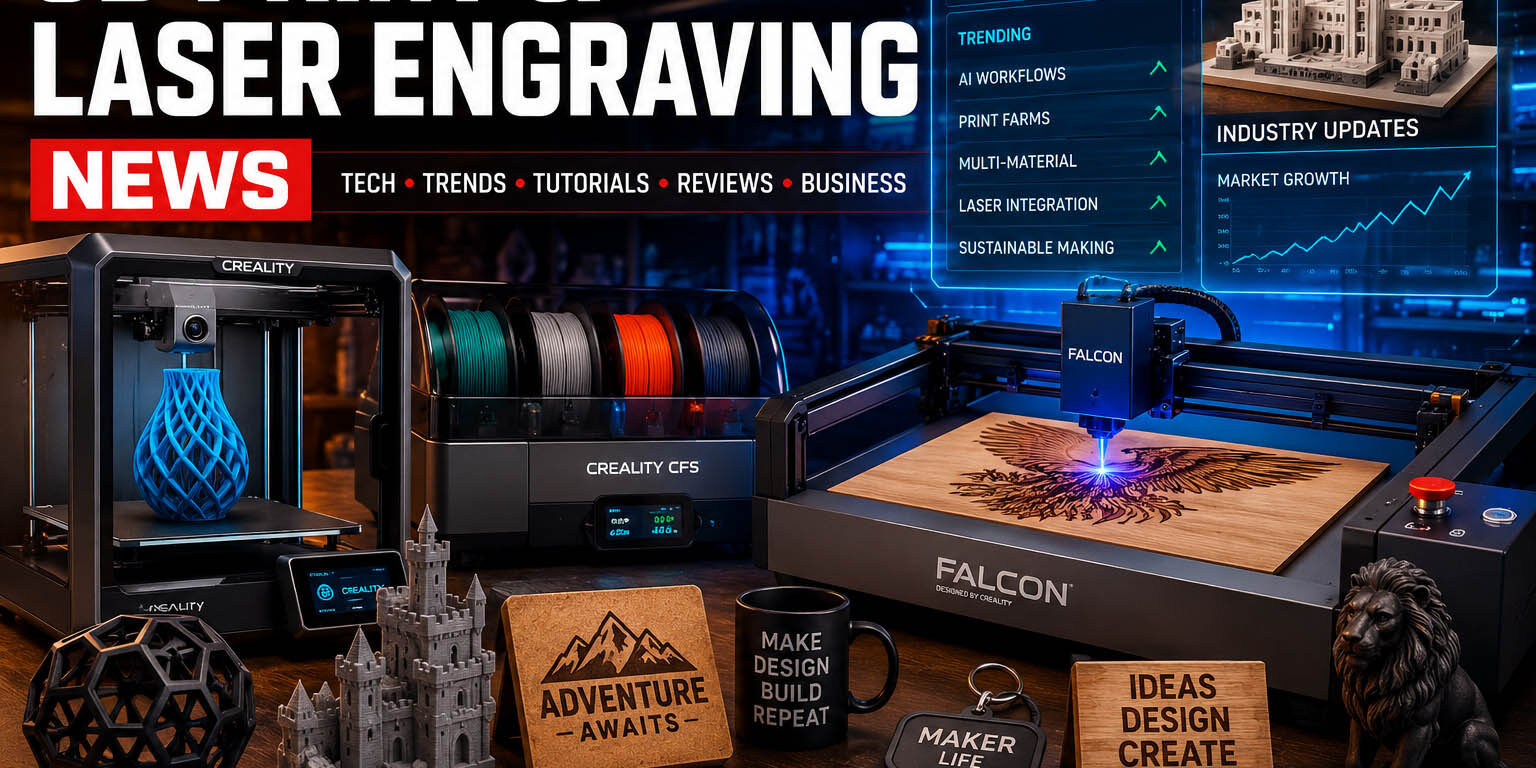
If you’ve been involved in 3D printing for any length of time, you’ve probably noticed a pattern.
Every year we’re promised something revolutionary.
A faster printer.
A bigger printer.
A smarter printer.
And honestly, sometimes it feels like the industry is stuck in an endless cycle of speed records and marketing buzzwords.
But after reviewing the biggest 3D printing news stories from the past week, something stood out to me.
The most interesting developments aren’t actually about printers anymore.
They’re about what happens around the printer.
Workflow.
Materials.
Automation.
Manufacturing.
The truth is, the industry is quietly shifting from a hobby-first mindset toward a production-first mindset. And if you’re someone who enjoys 3D printing, laser engraving, custom product creation, Etsy sales, workshop projects, and building systems that actually make money, this shift matters a lot more than another 100 mm/s of print speed.
Because while everyone else is arguing about benchmarks, the companies shaping the future are building ecosystems.
And that’s where things start getting really interesting.
Bambu Lab’s A2L Is About More Than Build Volume
The biggest consumer printer story this week continues to be the launch of the new Bambu Lab A2L, a large-format addition to the company’s lineup. According to the official announcement from Bambu Lab A2L, the machine offers a significantly larger build volume while maintaining the simplicity that made the A-series so popular. Industry analysis from TCT Magazine’s A2L coverage points to a growing demand for printers capable of handling larger projects without requiring users to split models into multiple parts.
Now, don’t get me wrong.
A bigger printer isn’t revolutionary.
We’ve had large-format printers for years.
But that’s just it.
The interesting part isn’t the printer.
The interesting part is what it says about the market.
Think about the projects that benefit most from larger build volumes:
- Cosplay armor
- Helmets
- Workshop organizers
- Product displays
- Signage
- Production tooling
Those aren’t necessarily hobby projects.
Those are production projects.
And manufacturers know it.
The truth is, we’re seeing more makers transition from printing things for themselves to printing things for customers.
That’s a completely different mindset.
The Speed War Is Finally Losing Its Grip
For the last several years, every major printer launch followed the same formula.
Faster.
Then faster again.
Then somehow even faster.
And honestly?
The industry needed that phase.
Speed improvements made desktop 3D printing dramatically more practical.
But we’re approaching a point where speed alone isn’t solving the biggest problems.
Because let’s be realistic.
A printer capable of 500 mm/s doesn’t magically solve:
- Failed prints
- Material organization
- Production scheduling
- Inventory management
- Customer fulfillment
The truth is, most makers don’t lose time because their printer is too slow.
They lose time because their workflow isn’t optimized.
That’s a much harder problem to solve.
And it’s exactly where the industry is heading.
AI Is Quietly Becoming the Most Important Upgrade
Let’s talk about AI.
I know.
Everybody talks about AI.
But that’s just it.
Most people are focusing on the wrong applications.
The biggest AI opportunity in 3D printing isn’t AI-generated dragons or AI-generated Benchy variants.
It’s workflow automation.
Research and manufacturing companies continue investing heavily in AI-powered monitoring systems capable of identifying print failures, mechanical issues, and quality defects before they become expensive problems. Emerging technologies are even using machine learning to automate inspection and post-production workflows.
Now imagine this for a moment.
You have a print farm running overnight.
Instead of manually checking machines every morning, software identifies:
- Failed prints
- Quality issues
- Production bottlenecks
- Maintenance requirements
Before you even walk into the workshop.
That’s not hype.
That’s practical.
And practical technology tends to win.
Every single time.
Industrial 3D Printing Is Moving Faster Than Most People Realize
While hobbyists debate printer specs, industrial additive manufacturing keeps quietly pushing the boundaries.
This week, researchers at the National Institute of Standards and Technology demonstrated a fascinating new metal printing technique that allows printers to create “alloys-on-demand” simply by changing laser movement patterns. Instead of requiring entirely new hardware, the technique uses software-controlled elliptical laser paths to mix metals during the printing process.
Now, if you’re printing PLA dragons, that probably sounds irrelevant.
But let me explain.
Many of the technologies we use on desktop printers today started in industrial manufacturing.
Automatic calibration.
Input shaping.
Advanced slicers.
Multi-material workflows.
Industrial innovation has a funny way of becoming consumer technology a few years later.
That’s why I always pay attention to these stories.
They’re often previews of where desktop printing is heading next.
Materials Are Becoming the Real Battleground
Here’s something I’ve been saying for years.
Everybody talks about printers.
Almost nobody talks about materials.
And honestly?
That’s backwards.
Because materials often have a bigger impact on your final product than the printer itself.
This week, Bambu Lab introduced a new material called PLA Pure, designed to help makers comply with toy safety and food-contact regulations. The material meets European safety requirements and simplifies part of the certification process for makers creating products for sale.
That might not sound exciting.
But the truth is, it represents something bigger.
We’re seeing filament manufacturers move beyond simply selling plastic.
They’re selling applications.
They’re selling compliance.
They’re selling business opportunities.
And that’s a major shift.
Because as more makers transition into selling products, material certifications become increasingly valuable.
Print Farms Are Becoming Small Manufacturing Facilities
One of the biggest trends I’ve noticed over the past year continues accelerating.
Print farms are becoming normal.
Not giant industrial operations.
Just regular makers running multiple machines efficiently.
The truth is, once you move beyond one printer, your biggest challenges change completely.
You’re suddenly dealing with:
- Scheduling
- Maintenance
- Inventory
- Materials
- Workflow management
Those aren’t hobby problems.
Those are manufacturing problems.
And honestly?
That’s exactly what’s happening.
The modern maker workshop is increasingly becoming a micro-manufacturing facility.
You can see it everywhere.
Etsy sellers.
Prototype businesses.
Custom product creators.
Small-batch manufacturers.
They’re all operating using the same basic model:
Multiple machines.
Automated workflows.
Repeatable processes.
Reliable output.
That’s manufacturing.
Whether we call it that or not.
The Future Is Connected Workflows
This is where things get especially interesting for creators who enjoy both 3D printing and laser engraving.
Because the future probably isn’t one magical machine that does everything.
It’s connected workflows.
Think about how many products benefit from both technologies:
- Personalized signs
- Custom gifts
- Workshop accessories
- Product packaging
- Business branding
- Small-batch production
3D printing creates the structure.
Laser engraving creates the identity.
And together?
You can create products that would have been extremely difficult or expensive to manufacture just a decade ago.
That’s a huge opportunity.
Especially for makers willing to think beyond individual machines.
Industrial Manufacturing Is Embracing Additive Production
One of the most fascinating stories this week came from Divergent Technologies, which unveiled a new industrial production system capable of dramatically increasing additive manufacturing output. Their new facility is designed around scalable digital manufacturing systems that can adapt production quickly without traditional tooling delays.
Now, before you dismiss that as defense-industry news, consider what it represents.
The truth is, additive manufacturing is steadily moving beyond prototyping.
We’re seeing it become production.
Real production.
Not experimental production.
Not “someday” production.
Actual manufacturing.
And that’s a trend worth watching closely.
Because once industrial systems mature, consumer systems often follow.
The Most Exciting Story This Week Isn’t a Printer
Honestly?
The most fascinating story I read this week wasn’t about a printer at all.
It was about batteries.
According to a recent report from The Wall Street Journal’s coverage of 3D printed batteries, companies are exploring ways to use additive manufacturing to create batteries with entirely new shapes and structural designs. Instead of forcing products to fit around batteries, batteries could eventually be printed to fit inside products.
Now think about that.
For decades, products have been designed around the limitations of battery shapes.
What happens when those limitations disappear?
That’s the kind of breakthrough that changes industries.
Not overnight.
But permanently.
What Makers Should Focus On Right Now
After reviewing this week’s biggest developments, five themes stand out.
1. Stop Chasing Specs
A better workflow beats a slightly faster printer almost every time.
2. Learn Automation
Whether it’s AI monitoring, print farm management, or production planning, automation is becoming increasingly valuable.
3. Pay Attention to Materials
The next major advantage won’t necessarily come from hardware.
It may come from what’s loaded into the printer.
4. Think Like a Manufacturer
Even if you’re only running one machine.
The habits scale.
5. Build Systems
The makers who succeed long term aren’t building printer collections.
They’re building production systems.
Final Thoughts
This week’s 3D printing news wasn’t dominated by a revolutionary new machine.
It was dominated by a pattern.
A pattern that’s becoming impossible to ignore.
Larger build volumes.
Smarter software.
Advanced materials.
AI-powered workflows.
Production-focused manufacturing.
The truth is, the industry is growing up.
And honestly, that’s a good thing.
Because while it’s fun to chase the latest hardware announcement, the biggest opportunities are increasingly appearing elsewhere.
In workflows.
In automation.
In materials.
In manufacturing.
And if you’re already combining 3D printing, laser engraving, customization, and content creation, you’re sitting right where the industry is heading.
Because the future isn’t just about making things.
It’s about building systems that make things efficiently.
That’s where the leverage is.
And that’s where the next chapter of 3D printing is being written.