
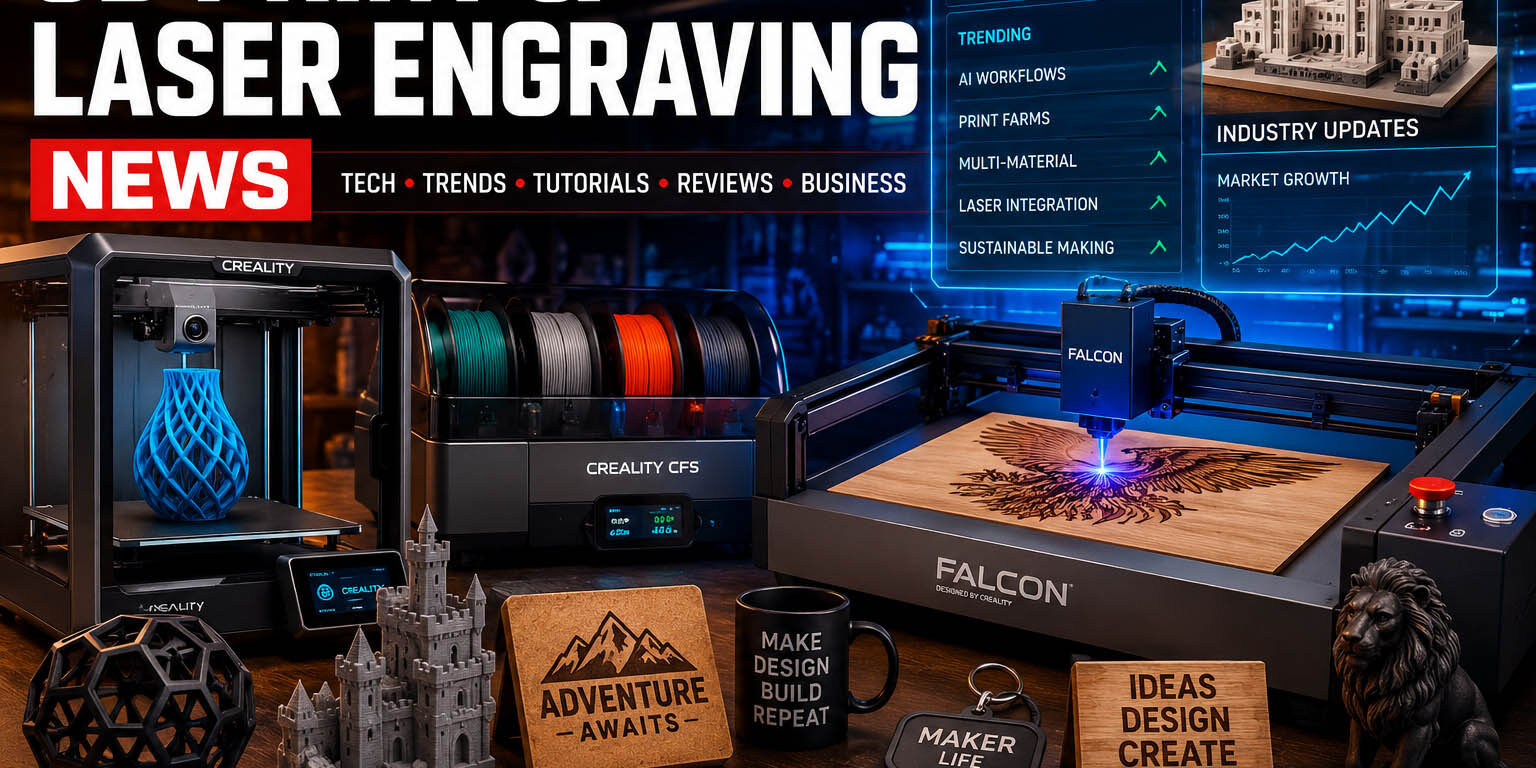
The Future of 3D Printing Isn’t Sitting on Your Desk Anymore
Something interesting has happened over the past few years.
Most people haven’t noticed it yet.
They’re still comparing printer speeds.
Still arguing about Benchy times.
Still obsessing over maximum acceleration settings and input shaping graphs.
And don’t get me wrong.
That stuff matters.
A little.
But that’s just it.
The biggest developments in 3D printing this week weren’t really about printers at all.
They were about workflows.
Systems.
Automation.
Manufacturing.
Because if you step back and look at everything happening across the industry right now, a pattern starts to emerge.
The companies winning aren’t necessarily building the fastest machines.
They’re building the smartest ecosystems.
And if you’re someone who enjoys both 3D printing and laser engraving, this trend should immediately grab your attention.
Because the truth is, the future looks a lot more like a connected workshop than a collection of standalone machines.
Creality Is Building an Ecosystem, Not a Product Line
One of the most interesting developments gaining attention throughout the additive manufacturing industry continues to be the expansion of the Creality ecosystem.
Recent coverage from VoxelMatters highlighted how Creality is positioning itself beyond simply being a printer manufacturer by connecting scanners, printers, lasers, software, cloud management, and even recycling systems into a unified workflow.
The truth is, this caught my attention immediately.
Because if you’ve followed my content for any amount of time, you already know I don’t look at tools individually anymore.
I look at workflows.
Imagine this:
You scan a broken component using a Raptor Pro.
You repair it digitally.
You print the replacement on a K2 Series machine.
Then move it over to a Falcon laser and engrave part numbers, logos, installation instructions, or customer branding.
That’s not a hobby workflow.
That’s manufacturing.
And honestly?
Many makers are already operating this way without realizing it.
They’re not hobbyists anymore.
They’re small-scale manufacturers.
The equipment has simply become affordable enough that the transition happened quietly.
AI Is Finally Becoming Useful Instead of Just Buzzword Material
Let’s talk about AI.
I know.
Every company on Earth suddenly claims their software is AI-powered.
Most of the time it means almost nothing.
But that’s just it.
The developments we’re seeing in additive manufacturing are actually becoming useful.
Industry discussions throughout the past week continued focusing on AI-assisted manufacturing systems, including print failure prediction, automated design validation, workflow optimization, and machine monitoring.
And honestly?
This is where AI starts making sense.
Not because it’s creating models.
Not because it’s generating artwork.
But because it’s removing friction.
Think about how much time gets wasted in a typical workshop.
Failed prints.
Bad supports.
Incorrect material settings.
Poor orientation choices.
Machine downtime.
The truth is, those problems cost more time than the actual printing process.
If AI can eliminate even a fraction of that waste?
That’s valuable.
Very valuable.
But let me explain why I’m still cautious.
AI is incredible until it isn’t.
And when it makes mistakes, it often makes them with complete confidence.
That familiar mix of awe and unease.
The people who will benefit most from AI aren’t the people who trust it blindly.
They’re the people who understand enough to know when it’s wrong.
That’s an important distinction.
The Bambu Lab Controversy Is About Much More Than Bambu Lab
One of the biggest stories continuing to ripple through the community involves ongoing disputes surrounding Bambu Lab, open-source licensing, and ecosystem control. Recent reporting from Tom’s Hardware and The Verge highlighted growing tensions involving AGPL licensing, third-party integrations, and efforts by independent developers to maintain open access to printer functionality.
Now don’t get me wrong.
Bambu Lab completely changed consumer 3D printing.
That’s simply a fact.
They raised expectations dramatically.
Automatic calibration.
Reliable multi-color printing.
Cloud monitoring.
High-speed operation.
User-friendly workflows.
They helped push the industry forward.
But that’s just it.
Every convenience comes with a tradeoff.
The more seamless an ecosystem becomes, the more control the company gains over your workflow.
And that’s where things get interesting.
Because makers love convenience.
But makers also love freedom.
Those two goals don’t always align.
The truth is, this isn’t really a Bambu story.
It’s an industry story.
The question isn’t whether one company is right or wrong.
The question is what kind of future makers actually want.
Open?
Closed?
Something in between?
That debate is only getting louder.
Metal Printing Just Took a Huge Step Forward
While most hobbyists focus on FDM machines, one of the most fascinating developments this week came from the industrial side of additive manufacturing.
Researchers at NIST demonstrated a new metal printing technique that allows printers to dynamically mix metals during the printing process using software-driven laser movement. Instead of requiring entirely new hardware, the process relies on elliptical laser paths that stir molten material and create entirely new alloy combinations during fabrication.
Now, before you stop reading because you think this only matters to aerospace engineers, hear me out.
Because this is exactly how disruptive technologies evolve.
Industrial first.
Consumer later.
We’ve watched this happen repeatedly.
Auto bed leveling.
Input shaping.
Lidar calibration.
Closed-loop monitoring.
All of these technologies started at higher levels before filtering down into consumer machines.
The truth is, today’s industrial innovations often become tomorrow’s maker tools.
And if history repeats itself, metal printing is going to become far more accessible than most people currently believe.
The Era of Desktop Metal Printing Might Be Closer Than You Think
Speaking of metal printing, another development worth watching is the appearance of significantly more affordable metal additive manufacturing systems.
A Colorado startup recently introduced a compact laser powder-bed fusion printer called the Scrap 1, targeting workshops, schools, and smaller manufacturers rather than large industrial facilities. With pricing dramatically lower than traditional industrial systems, it’s a glimpse of where the market may be heading.
Now don’t get me wrong.
We’re still nowhere near consumer-level metal printing.
Not yet.
But the truth is, the barrier is dropping.
And every time the barrier drops, innovation accelerates.
That’s what happened with desktop FDM printers.
That’s what happened with diode lasers.
That’s what happened with resin printing.
Accessibility changes everything.
Multi-Material Printing Is Finally Becoming Practical
For years, multi-color printing felt like social media content.
Rainbow dragons.
Gradient octopuses.
Color-changing toys.
It’s cool and all… but not that useful.
But lately?
That narrative is changing.
Companies are increasingly focusing on reducing labor and simplifying manufacturing workflows through advanced multi-material systems.
The goal isn’t color.
The goal is fewer production steps.
That’s a huge difference.
Imagine producing:
- Flexible hinges and rigid frames together
- Decorative surfaces and structural components simultaneously
- Functional assemblies that require minimal post-processing
Suddenly the value becomes obvious.
Because labor is expensive.
Assembly takes time.
Every additional step introduces another opportunity for failure.
The truth is, reducing production steps is often far more valuable than increasing print speed.
A printer that eliminates two hours of assembly time can be more useful than one that’s 20% faster.
Print Farms Are Becoming Legitimate Manufacturing Operations
One of the biggest misconceptions people still have is that print farms are just hobbyists with too many machines.
Honestly?
That perspective is outdated.
Industrial manufacturers are increasingly proving that distributed production systems can compete with traditional manufacturing in specific applications. Recent developments from companies like Divergent Technologies show how additive manufacturing facilities are scaling output dramatically through integrated production systems rather than individual machine performance.
And that’s the key point.
The conversation isn’t about printers anymore.
It’s about systems.
You can own ten printers and accomplish very little.
Or you can build an optimized workflow around three machines and outperform competitors.
Good luck getting anywhere if your workflow is held together by sticky notes and memory.
The future belongs to systems.
Not hardware.
Why Laser Engraving Remains One of the Smartest Complementary Technologies
This is the part that many 3D printing publications still overlook.
Laser engraving.
And honestly?
That’s a mistake.
Because laser engraving solves one of the biggest problems in additive manufacturing.
Differentiation.
Anybody can print a model.
Not everybody can transform it into a finished product.
When you combine:
- 3D printing
- Laser engraving
- Scanning
- Design software
- Product customization
You create something significantly more valuable than individual parts.
You create products.
The printer creates structure.
The laser creates identity.
The scanner creates adaptability.
Together, they create opportunity.
That’s why I believe creators who understand both additive manufacturing and laser workflows have a major advantage right now.
What You Should Actually Focus On Right Now
Let’s keep this practical.
Because information without action is just entertainment.
If you’re serious about building a workshop that stays relevant over the next few years, here are the trends