
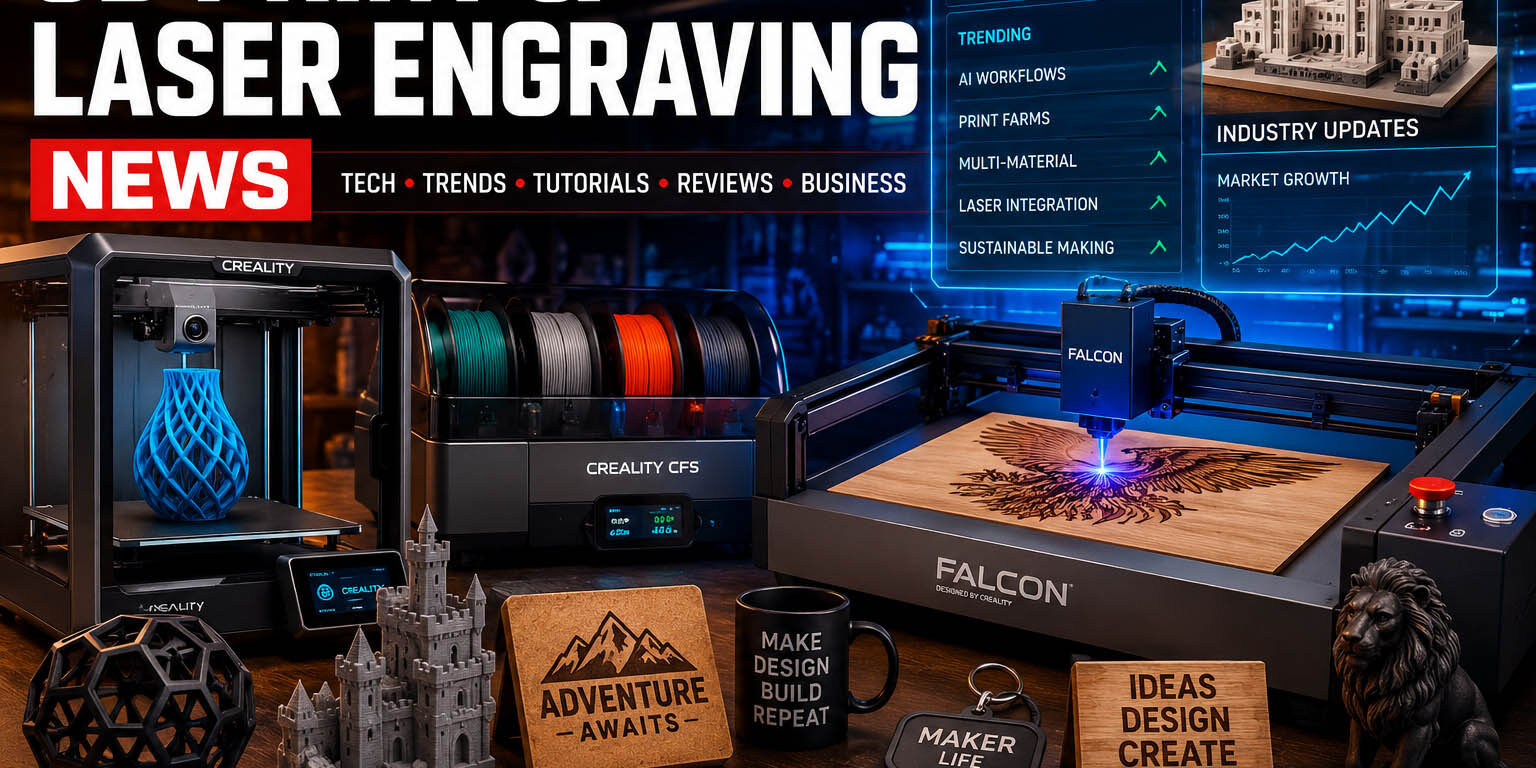
If you’ve been deep into 3D printing and laser engraving long enough, you eventually notice something strange happening.
The hobby slowly stops feeling like a hobby.
At first, it’s simple.
You buy a printer.
You print random things.
You learn slicer settings.
You fight bed adhesion at 2 AM while questioning your life choices.
Normal stuff.
But then something changes.
You start organizing workflows.
You begin thinking about production time instead of just print quality.
You care about repeatability.
Consistency.
Material costs.
Workflow bottlenecks.
And before you realize it, you’re no longer thinking like a hobbyist.
You’re thinking like a manufacturer.
And honestly?
This week’s 3D printing news reinforced that shift everywhere.
Because over the past seven days, the industry kept moving in the same direction:
Integrated manufacturing systems.
Not just printers.
Systems.
And if you’re already combining 3D printing with laser engraving, scanning, product finishing, or custom product workflows…
You’re probably much closer to the future than you think.
Creality Is Building Something Bigger Than Just Printers
One of the biggest things that stood out this week came from Creality and its continued push toward a connected manufacturing ecosystem.
Coverage from VoxelMatters highlighted how Creality is moving far beyond simply selling printers.
They’re building workflows.
And honestly?
That matters more than people realize.
Because if you look at the tools many makers already use:
- K2 Series printers
- Falcon laser systems
- Raptor scanners
- Creality Print
- Falcon Design Space
- Cloud management systems
You start realizing something important.
These machines aren’t isolated anymore.
They’re becoming interconnected production tools.
That’s a massive shift.
Imagine scanning a broken part with a Raptor Pro.
Repairing it digitally.
Printing the replacement.
Then laser engraving labels, branding, or assembly instructions directly onto the final product.
That’s not hobby-level thinking anymore.
That’s digital manufacturing.
And the truth is, smaller creators now have access to workflows that used to require entire industrial departments.
That’s kind of insane when you really think about it.
AI Is Quietly Becoming the Workshop Assistant Nobody Asked For
Now let’s talk about AI.
Yeah, I know.
Everybody talks about AI now.
Every software company suddenly claims they’re “AI-powered.”
Most of the time, it’s marketing nonsense.
But that’s just it.
The real AI shift happening in 3D printing isn’t flashy gimmicks.
It’s workflow reduction.
Research and manufacturing discussions covered by 3DPrint.com and Autodesk Research continue showing AI moving deeper into additive manufacturing workflows — especially around slicing optimization, print monitoring, simulation, and predictive maintenance.
And honestly?
This changes your role completely.
Because instead of manually tweaking every variable yourself…
You’re increasingly supervising automated systems.
That’s different.
Very different.
You’re reviewing AI decisions instead of directly controlling every setting.
And that sounds amazing right up until the AI confidently makes a horrible decision.
Because it absolutely will.
The truth is, AI-assisted manufacturing creates a weird tension.
You gain efficiency.
But you also lose direct control over certain decisions.
That familiar mix of awe and unease.
And honestly?
The people who thrive moving forward won’t be the ones blindly trusting AI.
They’ll be the ones who understand when to override it.
Print Farms Are Quietly Becoming the New Small Business Model
For years, critics loved saying:
“3D printing doesn’t scale.”
Too slow.
Too inconsistent.
Too unreliable.
And honestly?
That criticism used to be fair.
But over the past week, manufacturing discussions continued showing how decentralized print farms are becoming legitimate production infrastructure instead of hobby experiments. Coverage from 3D Printing Industry reinforced how additive manufacturing is increasingly being measured through throughput and production efficiency rather than raw machine count.
And honestly?
You’re probably already seeing this shift yourself.
Maybe not industrially.
But if you’re running:
- Multiple printers
- Product batches
- Queued workflows
- Etsy production
- Custom laser engraving jobs
You’re already operating like a micro-manufacturer.
You just haven’t framed it that way yet.
And framing changes everything.
Because once you stop asking:
“What cool thing can I print?”
And start asking:
“What products can this workflow consistently produce?”
Your entire mindset shifts.
You start caring about:
- Workflow efficiency
- Material handling
- Maintenance schedules
- Product consistency
- Time optimization
That’s manufacturing thinking.
And honestly?
That’s where the real opportunity is right now.
The Bambu Lab Situation Reveals a Much Bigger Problem
One of the most talked-about stories this week continued revolving around Bambu Lab and growing backlash surrounding ecosystem control and open-source licensing concerns.
Reports from Tom’s Hardware and The Verge highlighted escalating tensions involving third-party software integrations and modified workflow tools.
Now, don’t get me wrong.
Bambu completely changed consumer 3D printing.
Their machines raised expectations overnight.
Automatic calibration.
Reliable multi-color printing.
Cloud integration.
AI-assisted monitoring.
That stuff mattered.
A lot.
But that’s just it.
The more convenient ecosystems become…
The more control companies gain over your workflow.
And honestly?
That’s where things start getting uncomfortable.
Because makers love convenience.
But they also love freedom.
Those two things don’t always coexist peacefully.
The truth is, this debate isn’t really about one company.
It’s about the future direction of the industry.
Do makers want:
- Closed ecosystems?
- Open ecosystems?
- Hybrid systems?
That conversation is only getting louder.
Multi-Material Printing Is Finally Becoming Practical
For years, multi-material printing mostly felt like social media bait.
Rainbow dragons.
Color gradients.
Fancy Benchys.
It’s cool and all… but not that useful.
But recently?
That’s changing.
Coverage from All3DP and RAPID + TCT highlighted growing interest in production-focused multi-material systems designed around workflow simplification instead of visual gimmicks.
And honestly?
This matters way more than people realize.
Because the real value of multi-material workflows isn’t color.
It’s reducing production steps.
Let me explain.
Imagine printing:
- Flexible hinges
- Structural frames
- Decorative surfaces
- Embedded functional components
All in a single job.
No secondary assembly.
No extra labor.
No additional production stages.
That changes everything.
Because labor becomes one of the biggest bottlenecks once production scales.
Reducing labor is where the real leverage lives.
Laser Engraving Is Becoming the Perfect Companion Workflow
Now let’s bring this back to something most traditional 3D printing blogs still completely overlook.
Laser engraving.
Because honestly?
Laser workflows pair incredibly well with additive manufacturing.
3D printing creates structure.
Laser engraving creates finish.
And when combined?
You suddenly have workflows capable of producing:
- Personalized products
- Branded merchandise
- Functional prototypes
- Product packaging
- High-margin custom goods
And the truth is, customers don’t really care how something was manufactured.
They care about the final product.
That’s it.
Combining technologies creates products that feel significantly more premium.
Simple as that.
Materials Are Becoming More Important Than Printers
Here’s something most people still underestimate.
Materials.
Everybody obsesses over printers.
Very few people obsess over what actually goes inside them.
But honestly?
Materials may be becoming the biggest competitive advantage in the maker space.
Reports from Protolabs and Materialise continue emphasizing how advanced materials are reshaping manufacturing workflows across industries.
And if you’ve experimented with:
- Carbon fiber blends
- TPU
- Wood-filled filaments
- Engineering materials
You already understand this.
Material choice changes everything.
Customers notice:
- Texture
- Weight
- Durability
- Surface finish
Far more than they notice your printer specifications.
And once laser engraving enters the equation?
Material knowledge becomes even more important.
Because some materials engrave beautifully.
Others absolutely do not.
Knowing the difference becomes a real advantage.
Filament Recycling Could Become a Bigger Deal Than People Expect
One of the quieter stories emerging recently involves filament recycling systems.
And honestly?
This deserves more attention.
Creality’s ecosystem demonstrations included filament recycling integration aimed at reducing waste and improving long-term material efficiency.
Now, don’t get me wrong.
Most makers aren’t recycling filament right now.
But that could change quickly.
Especially as print farms continue growing.
Because waste becomes expensive.
Very expensive.
Failed prints.
Support waste.
Calibration runs.
Prototype iterations.
It adds up fast.
And the truth is, sustainability only truly scales once it becomes economically beneficial.
That’s when industries actually adopt it.
What You Should Actually Focus On Right Now
Let’s make this practical.
Because information without action is just entertainment.
If you’re serious about building workflows around 3D printing and laser engraving, here’s what actually matters right now.
1. Build Systems, Not Random Tool Collections
Every machine should fit into a workflow.
Not just sit on a shelf looking cool.
2. Learn Scanning
3D scanning is becoming incredibly important.
The ability to digitize real-world objects creates huge opportunities.
3. Understand Materials Deeply
Material knowledge is becoming a major competitive advantage.
Especially for premium products.
4. Pay Attention to AI
Not because it’s trendy.
Because it’s increasingly embedded into the software you already use.
5. Combine Technologies
3D printing plus laser engraving is significantly more powerful than either technology alone.
That’s where many opportunities exist right now.
Final Thoughts
This week’s 3D printing news wasn’t really about one revolutionary printer.
It revealed something much bigger.
The maker space is slowly evolving into decentralized manufacturing.
AI-assisted workflows.
Integrated ecosystems.
Laser-enhanced production.
Scanning.
Multi-material systems.
Filament recycling.
All converging toward the same destination:
Smarter production systems.
And honestly?
That’s where the real opportunity is right now.
Because while most people are still thinking purely about printers…
You can start thinking about workflows.
And once you make that mental shift — once you stop treating your workshop like a collection of machines and start treating it like a production system — everything changes.
That’s where the leverage is and that’s where things start getting really interesting.